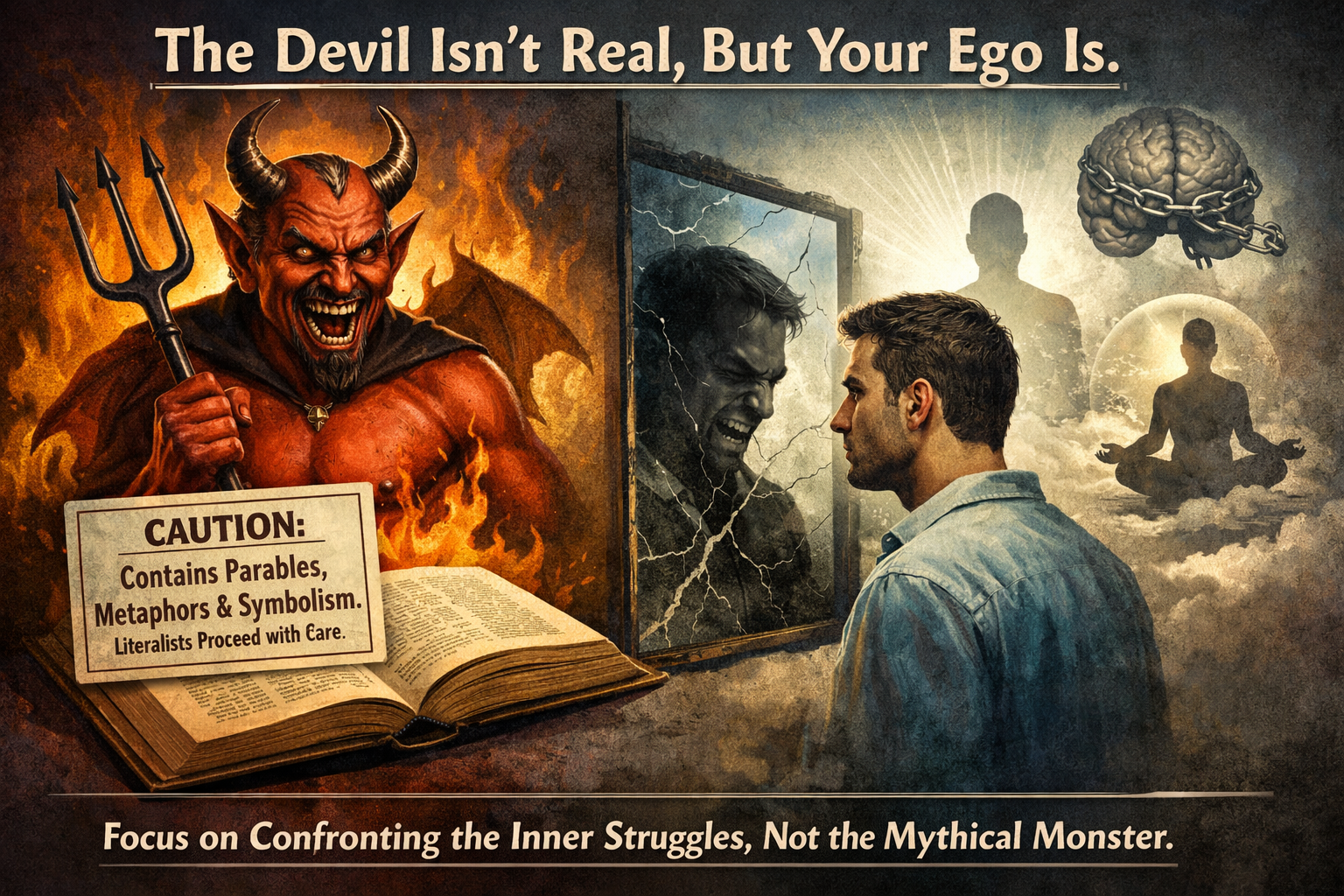
‘Satan’ functions as a symbolic figure in biblical literature rather than a literal being, representing psychological or internal forces that are meant to be understood and overcome. While depicting this figure as a literal being rather than the actual aspects of the human psyche it is intended to represent, the readers are then lead astray from actually overcoming these internal obstacles. This also highlights the dangers of literal readings of the bible, in which readers of the texts walk away not understanding the subtext of the stories but rather with a belief that there were literal talking snakes and talking donkeys in the course of human existence. This should trouble many. The Bible ought to come with a warning label: “Caution: This text contains extensive use of parables, metaphors, and symbolism. Literalists, proceed with care.”
The Bible’s depictions of the devil were never intended to be taken as literal, actual horned, red-skinned demons dancing around with a pitchfork and a tail. Such imagery was crafted to personify an abstract concept—the human ego—in a vivid, memorable way, particularly for ancient audiences who relied heavily on vivid and symbolic storytelling. These dramatizations served to illustrate the internal struggles between our higher self and egoic impulses within our consciousness, not to present a literal monstrous villain lurking in the shadows. Such symbolic depictions aren’t necessary anymore and keep our eyes off the target we should be focusing on, namely our egos, which there are plenty of well tested methods to dissolve it.
Frankly, Christian ministers who are describing the human ego as a literal demonic monster are not doing members of their congregation any favors or services. Without knowing what the exact ‘enemy’ or source of the problem is, then the problems for their church members can’t be addressed and resolved. In the ancient days, personifying our problematic egos as demon monsters to less educated/refined audiences made sense. However, in contemporary society, those fantastical embellishments are no longer necessary, neither is a narrative framework needed to explain actual psychological elements of our consciousness. An honest minister would say:
“There is no devil, there is only the ego, the part of your mind that creates a story about who you are, a mental identity. It’s not you, it’s your inner narrator, always trying to define you and protect you from feeling hurt, left out, or embarrassed. It’s not “bad” — it’s just trying to keep you safe. But if you let it run the show, it can make you anxious, defensive, or disconnected from who you really are. The real you — underneath the ego — doesn’t need to prove anything. It’s calm, curious, confident, and connected. Learning to notice when the ego is reacting gives you the power to choose how you want to respond, instead of just reacting automatically”
To interpret many biblical narratives and parables as historical fact is to miss their deeper, intended purpose. Unfortunately, both theists and atheists often fall into this trap. Atheists may dismiss the Bible outright, pointing to stories like the Garden of Eden as myths and in some cases they’re right. Of course there wasn’t a talking snake in a magical garden; the story was never meant to be a factual account. It is clearly an allegory, rich with symbolic meaning, addressing human nature, temptation, the loss of innocence, humanity’s embrace of our egos and the origins of self-awareness.
The presence of fantastical elements like a talking snake was the first clue that these narratives were designed to communicate spiritual and psychological truths through metaphor, not to serve as entries in a history textbook. For atheists to critique them as failed historical documents is to judge poetry for not being journalism.
Likewise, many theists err in the opposite direction—insisting that stories like Genesis must be literal, fearing that to view them symbolically might somehow undermine their faith or invite the divine wrath of god. But nowhere in scripture is there a threat of eternal punishment for interpreting allegory as allegory. The true danger lies in clinging to surface meanings and missing the profound wisdom buried within.
In truth, these ancient stories invite us into deeper reflection—not about snakes and forbidden fruit—but about the human condition, our spiritual evolution, and the eternal struggle between the ego and the divine self. To read them well is not to ask “Did this happen?” but “What truth is this trying to reveal?”
Of course biblical stories personifying the human ego as a monster due to it being the source of much of humanity’s problems is not the only time in historical creative writing the ego was the subject and center of the story. Other notable examples Include:
- Plato’s Allegory of the Cave (380 BCE)
- The Epic of Gilgamesh (Mesopotamia) (2100 BC)
- The Story of Narcissus (Greek Mythology) (8 BC)
- The Bhagavad Gita (Hinduism) (400 BC)
- The Tower of Babel (Hebrew Bible) (600 BC)
- Icarus and Daedalus (Greek Mythology) (8 CE)
- The Descent of Inanna (Sumerian Mythology) (1900 BC)
- Laozi and the Tao (Taoist Philosophy) (600 BC)
- Prometheus (Greek Mythology) (700 BC)
In truth, the human ego lies at the root of countless problems we face as a species. Yet unless we set our sights on the true source, we can never hope to address it. When we project blame onto a fantastical caricature of evil, religion loses credibility and humanity is left without real solutions. The struggles born of ego are not the work of some external boogeyman, they are deeply human, well-documented through psychology and therapy alike. Many authentic spiritual traditions understand this and provide practical, time-tested paths for transcending the ego. Their wisdom also does not point us toward mythical demons, but toward honest self-confrontation and inner transformation.
Literalists Approach The Bible With Care and The Importance of Identifying Figurative Language
Beyond the instances of the so-called “appearances” of the devil in the Bible, it isn’t discussed nearly enough that one of the greatest risks of the text lies in the widespread tendency to interpret its extensive use of allegory and other literary or poetic devices literally. These devices were deliberately employed by its authors to teach and convey deeper spiritual truths. Like any work of art or literature, the Bible is the product of creative and symbolic minds who relied on metaphor, symbolism, and narrative framing to communicate ideas and lessons. To take these symbolic elements at face value is to miss many of the underlying meanings they were intended to express. Jesus, in particular, was a teacher who relied heavily on symbolism, parables, hyperbole, and metaphor to communicate his message.
For many Christians, there is a deep fear attached to not taking everything literally—because for them, the perceived risk is eternal punishment. So at its core, this insistence on literalism is rooted in fear. Ironically, this runs directly counter to Jesus’ own teachings, which repeatedly emphasize the importance of releasing and letting go of fear. This literalist mindset has gone so far within mainstream Christianity that some interpret Jesus’ statement that he came “not to bring peace but a sword” as a literal declaration of violent intent, as if he were positioning himself as a warrior. Yet the overwhelming consensus among biblical scholars is that this was a symbolic statement meant to describe how his teachings would inevitably disrupt and subvert the religious and political establishment of his time. Despite this, the quote is frequently cited by those eager to argue that Jesus was not a pacifist or an advocate for peace.
For this reason, Jesus’ teachings must be approached with the understanding that he consistently communicated in a poetic and symbolic style, making frequent use of figurative language and even exaggeration to drive his points home. To strip that language of its symbolic intent is not only to misunderstand him, but to fundamentally miss what he was trying to convey.
This is, of course, not limited to the Gospels. Going all the way back to the book of Genesis, the Bible opens with what is a very obvious parable: the story of Adam and Eve. The narrative signals this immediately through its use of fantastical elements, such as a talking snake. The story is not meant to function as a literal historical account, but as a symbolic depiction of humanity’s ongoing struggle between our higher spiritual consciousness and our egos or intellects. The story ends with the ego prevailing, symbolized by humanity being “cast out” of paradise after choosing ego-driven control over spiritual awareness.
At its core, the story describes how human beings lost the ecstasy and bliss of our higher, universal consciousness by repeatedly opting for lower egoic thinking—driven by a desire for control, separation, and self-definition. God “kicking humans out” of paradise is not a literal expulsion, but a metaphor illustrating how happiness and inner peace are lost when we operate primarily from our egoic and intellectual selves rather than from our higher spiritual nature.
For Christians who use this story as justification to reject established science, such as evolution, the point and purpose of the narrative has been completely missed. The resistance to reading Genesis symbolically appears, once again, to be rooted in fear—specifically, the fear of being condemned to hell for interpreting the story as a parable rather than historical fact. Yet there is nothing in the Bible that suggests there is any punishment for rejecting creationism as the definitive explanation for human origins.
This insistence that every biblical story must be historically accurate comes entirely from fear, despite Jesus’ repeated teachings to let go of fear and trust that our source is Love. It is especially puzzling given that nowhere in scripture is there a warning that failing to interpret these stories literally results in eternal punishment. That was never a stated requirement. Many of these narratives exist to convey specific truths and lessons, not to serve as scientific or historical documentation.
Leading a life in accordance with the principles and teachings of Jesus is far more important than believing that every single story in the Bible happened literally as written. For those who insist on creationism, it often suggests that they believe affirming the literal truth of every passage is somehow essential, even when that fixation distracts from actually practicing the more important lessons—unity, loving others, forgiveness, compassion, and avoiding unnecessary conflict. Human nature tends to look for the path of least resistance, and in my experience, after encountering countless Christians, many openly admit they believe all that is required is to proclaim belief in Jesus and affirm that every story in the Bible is literally true in order to have their “pass into heaven” validated. That’s not how this works.
A healthier response to the story of Adam and Eve would be to let it inspire a desire to return to the state of higher consciousness the story points toward, using the methods Jesus taught—namely, relinquishing control and loosening attachment to identity, ego, and the body. This is not abstract theology; it is a practical methodology aimed at restoring the bliss and inner peace humanity lost when we collectively elevated ego and intellect as our primary mode of living. These teachings are not unique to Christianity. They appear across multiple spiritual traditions, and they work consistently.
Unfortunately, mainstream Christianity has misrepresented Jesus’ teachings for nearly two thousand years in various ways. This has understandably led many people to leave the faith after concluding that his teachings “don’t work,” when in reality the focus was shifted toward ideas Jesus never taught, or in some cases toward values that directly contradict his message. Today, it is not uncommon to see influential, self-identified Christians openly argue against caring for the poor, the sick, or immigrants, while advocating conflict rather than peace. Pointing this out should not be considered controversial or judgmental—it is a verifiable observation, one that is easily seen in modern political and religious discourse. I am certainly not the only one who has noticed this.
Jesus often referred to our source as our “our father” and this was just another use of symbolism in his teachings. Our father surrounds us, within all of us and is present in all things. We are all eternal reflections of our source, which is why Jesus taught his students to see all others as brothers/sisters since we are all in fact one. This should always be remembered.
More tragically, the constant literal interpretations of Jesus’ words led to the misinterpretation of his declarations that he was “one with our Father” as a claim of actually being God himself, which undeniably contributed to him getting executed by the state. However, he was teaching all his followers to achieve this same oneness with our Father via teachings of non-dualism, teachings of peace, forgiveness and self reflection. Using metaphorical language was a common tool in his belt when he spread his message and his teachings also suggest that we are all ultimately our Father’s children, not only him. The experience and profound feeling of oneness with the universe and all is commonly reported by all who experience this profound experience of enlightenment. This is undoubtedly what Jesus was referring to. That oneness with all is a very specific feeling that can be reproduced by anyone, yourself included.
To approach Jesus’ words and teachings (and many other biblical stories) as a literalist is to risk overlooking its profound spiritual lessons. The symbolism, hyperbole, parables and metaphors Jesus employed are meant to transcend mere words and invite readers into a greater understanding of our shared oneness.
Many Blessings Your Way! Join my mailing list if you want occasional updates.
I do not spam email boxes and will not try to sell you anything!
Relevant Posts Below






Leave a Reply